

What is TMS?
TMS usually stands for Transport Management System — sometimes also Traffic Management System. Both essentially describe the same thing: planning, managing and following up transports and movements in the business.
In practice, it is the system that helps you receive orders, plan runs, assign vehicles and drivers, track status and see what is happening on the road or on site. Dispatch, route plans, maps and follow-up — that is the core of what many mean when they say TMS.
For transport and contracting companies, it is often the most important digital step: stop living in phone calls, Excel and paper, and get a shared picture of what needs to be done, by whom, and when it is complete.
Why is it called that?
The abbreviation comes from English and the industry habit of describing management of transport or traffic as its own product category. Vendors and consultants use TMS as an umbrella term — much like CRM for customer relations or ERP for finance.
It sounds technical and advanced. The problem is that many people outside the industry do not recognise the abbreviation at all. And even within the industry, TMS can mean different things: maps and GPS only for some, full order and dispatch management for others, sometimes just route optimisation.
That is why it helps to ask: what do we actually need to get in order? Often the answer is not just “a TMS” — but the full chain from order to invoice.
What a TMS usually does well
A focused TMS is strong on the operational side of transport:
- orders and driving assignments
- planning and allocation of vehicles and staff
- dispatch — status, position, deviations
- communication with drivers and plant operators in the field
- follow-up of completed runs and deliveries
These are areas where Telme has long experience. Dispatch on a map, driving orders in the app, messages to the field and clear job status — that is exactly what many search for when they look for a TMS or dispatch system.
Where TMS ends — and everyday work continues
In reality, work rarely stops when the truck has finished or the machine is shut down. Back at the office, time must match, materials and items must be recorded, documentation must go to finance and invoices must be sent. Staff administration, schedules, absence and sometimes payroll must connect to what was actually done.
A pure TMS rarely solves all of that. Then other systems are added: time reporting, payroll data, finance, perhaps HR and perhaps manual Excel lists in between. Information has to be moved, double-entered and chased — and much of the benefit of digitalisation disappears.
That is when many companies realise they need more than a TMS label on the box.
Telme is more than a TMS
Telme starts where TMS is at its best — orders, planning, dispatch and the field — but extends into a complete platform for transport, logistics and contracting.
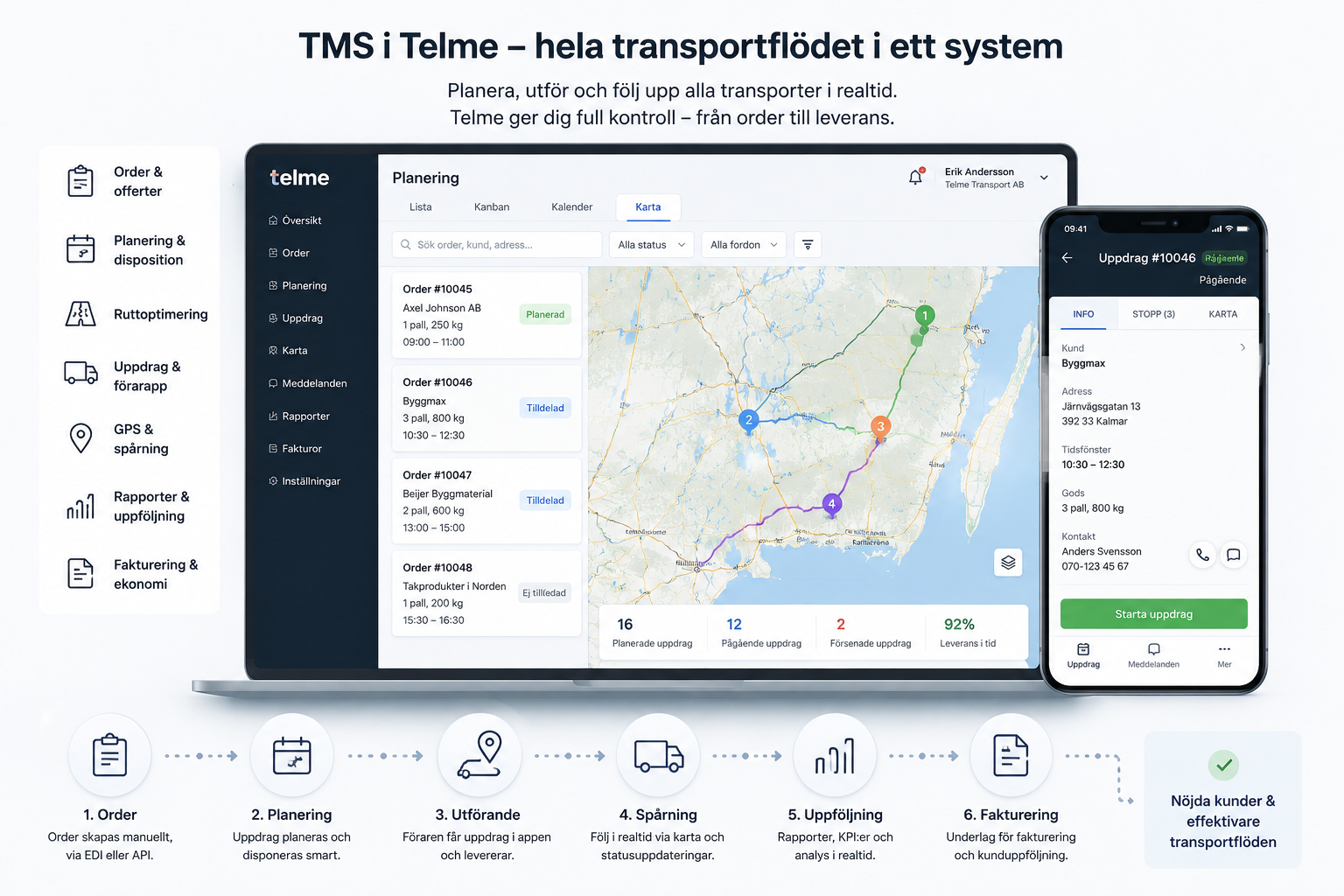
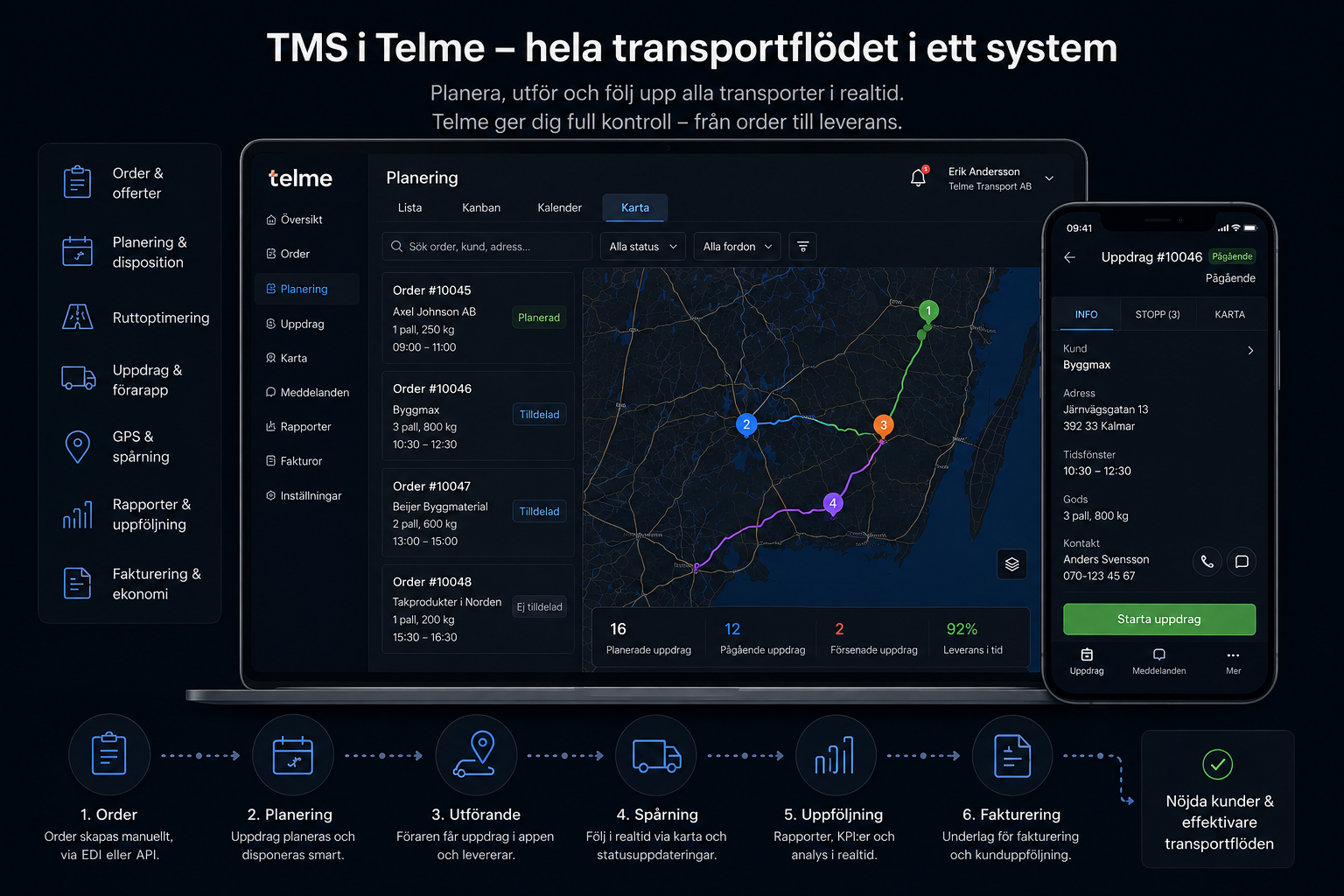
That means the same flow can carry all the way:
- Orders and dispatch — plan, assign and follow up jobs in real time
- Telme Go in the field — drivers and operators start, report, document and complete in the app
- Time and attendance — linked to what was done, not as a separate side track
- Payroll and HR administration — data that connects to real assignments
- Finance and follow-up — from completed work to invoice data, with integration to systems such as Visma and Fortnox
- The whole organisation — the same platform can also support HR, service, property and other parts of the business when needed
The point is not to do everything at once, but to avoid gaps. When orders, time, staff and finance share the same foundation, it becomes easier to grow, follow up and protect margins — without everyday work getting stuck between five different systems.
When does Telme fit the “we need a TMS” question?
If you are looking for dispatch and transport control — yes, Telme fits. But it fits especially well when you also want to:
- reduce double entry between field and office
- get a faster path from completed work to invoice
- give drivers and operators a modern way of working on mobile
- build a system landscape that holds together as the business grows
Then the question is not just “which TMS should we buy?” — but “how do we make the whole flow work?”
Next steps
Read more about Telme for logistics and transport, explore features and modules, or book a demo and we will show how dispatch, the field and follow-up connect in practice.